
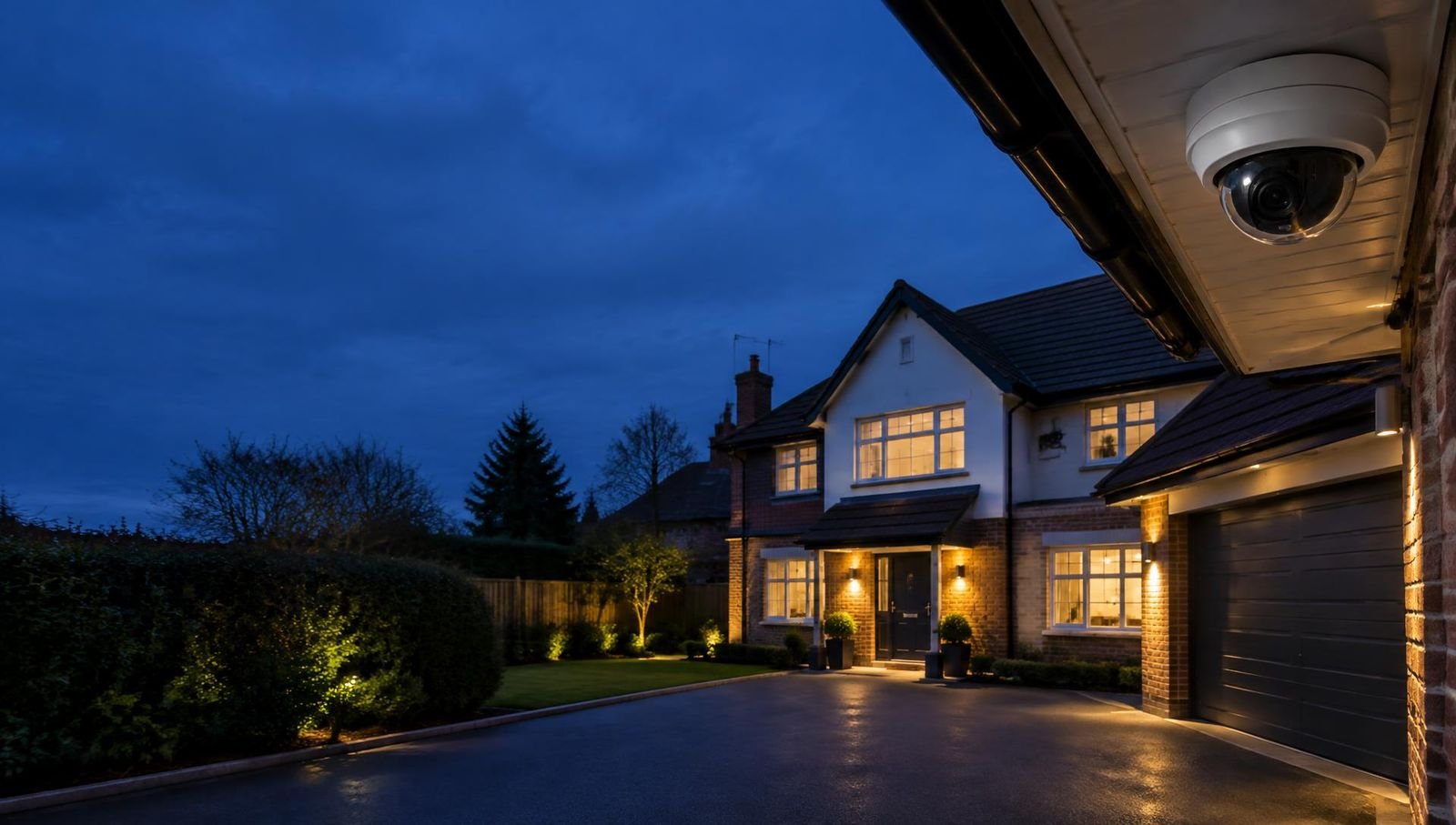
CCTV installation across Surrey
Cameras for houses, shops and workplaces. We plan them with you on site and leave every one showing in an app on your phone.
Sketch out your CCTV
Pick your property type and tap the spots that matter. The planner shows roughly how many cameras, the camera we’d usually put in each spot and the recorder it needs. Send the list to us and the survey starts from what matters to you.
Tap a number on the drawing or a button to add that camera.
CCTV we fit
From a single doorbell to cameras across a whole site.

Home CCTV
Coverage for the drive, the door, the gate at the side and the garden, saved round the clock to a recorder indoors.

Business CCTV
Shops, offices and workshops covered inside and out, with footage you can hand straight to the police or your insurer.

Video doorbells
Answer the door from wherever you are, and keep a clip of every caller.

Colour at night
Cameras that keep recording in colour after dark, so a face or a car is easy to make out.

Viewing on your phone
The app installed for you and the rest of the household, with notifications when a person or car turns up.

Repairs and upgrades
Old systems checked, faulty cameras replaced and analogue kit upgraded to sharp new cameras.
The cameras we choose between
No single camera suits every wall. Every camera is chosen for its own spot, then record them all on one recorder in your home or premises.
- Turret
- A short, rounded camera with a wide view and good infrared. Our first pick for most houses, as there’s no dome to catch reflections at night.
- Dome
- Low profile and hard to tamper with. Suits porches, ceilings, shop floors and shared hallways in blocks of flats.
- Bullet
- Obvious on purpose, which puts people off. Reaches further down a long drive, a yard or a car park.
- Varifocal
- The engineer adjusts the lens on site to frame a face at the gate or a number plate far down the drive.
- Colour night vision
- Uses a little light to record in colour after dark, so you can tell a red coat from a blue one.
- Smart alerts
- The camera tells people and vehicles apart from foxes, rain and swaying branches, so your phone only buzzes when it matters.
- Pan, tilt and zoom
- Swings round to track movement over wide open ground, and you can steer it yourself from the app.
- Number plate cameras
- Read plates at the entrance to a business site or private car park, even at night.
Resolution runs from 4MP to 4K, matched to the job, all recorded on a network video recorder (NVR) with viewing on your phone set up as standard.
How a CCTV job runs
Most homes take a day. Bigger sites get a written plan first.
Step 1 of 4
A walk round together
An engineer, not a salesperson, looks at how people approach your property and where you’d want to see.
Step 2 of 4
A clear plan
You get a list of cameras and where each one goes, with nothing added that you don’t need.
Step 3 of 4
A tidy install
Wiring is tucked away wherever the walls let us, and each camera is pointed at your land, not next door’s.
Step 4 of 4
Live in your hand
We don’t go until each camera shows in the app and you’ve tried finding and downloading a clip yourself.
Footage that is actually useful
A camera is only worth having if its recording helps when something happens. That means seeing faces and number plates clearly, not just shapes moving at the edge of the picture.
Height and angle count for as much as the model of camera. A camera set too high sees the tops of heads, and one pointing straight at a floodlight or the setting sun turns faces into silhouettes. We place each one to cover the way people actually come and go.
The recorder matters too. It stores everything locally, so footage is still there if the internet drops, and lets you play back and save clips from your phone when you need them.
CCTV questions
How many cameras do I need?
For a typical house, two to four does it, covering the approach, the drive, any side path and the garden. Use the planner above to get a feel for your property.
Will I be able to check the cameras when I’m out?
Yes. Live pictures and recordings are on your phone, a tablet or a laptop wherever you have a connection.
How far back can I look?
Typically several weeks. More cameras fill the storage faster, so we choose the recorder’s drive to match how long you want to keep.
Can my cameras see the road?
They can, but footage of a public road or a neighbour’s garden brings legal duties with it. We angle each camera at your own land where we can and explain what to do if they can’t.
Do cameras work in the dark?
Yes. All our cameras see at night, and many record in colour using a small light or very sensitive sensors.
Another firm fitted our cameras. Will you look at them?
Happily. We service, repair and modernise most brands regardless of the installer.
Do I need to tell my neighbours?
It’s good practice if a camera might take in their property. We aim cameras to keep to your land wherever possible.
Will CCTV work if the internet is down?
Yes. Our systems record to a recorder in the house, so they keep working. You just can’t view remotely until the internet is back.
Book a CCTV survey
Home and business CCTV, doorbells, repairs and upgrades across Surrey, Kent, West Sussex and south London.
CCTV installers across the region
Surrey
Redhill, Reigate, Guildford, Woking, Epsom, Dorking, Leatherhead, Camberley, Farnham, Godalming, Esher, Walton-on-Thames, Weybridge, Cobham, Staines and every town between. Surrey